
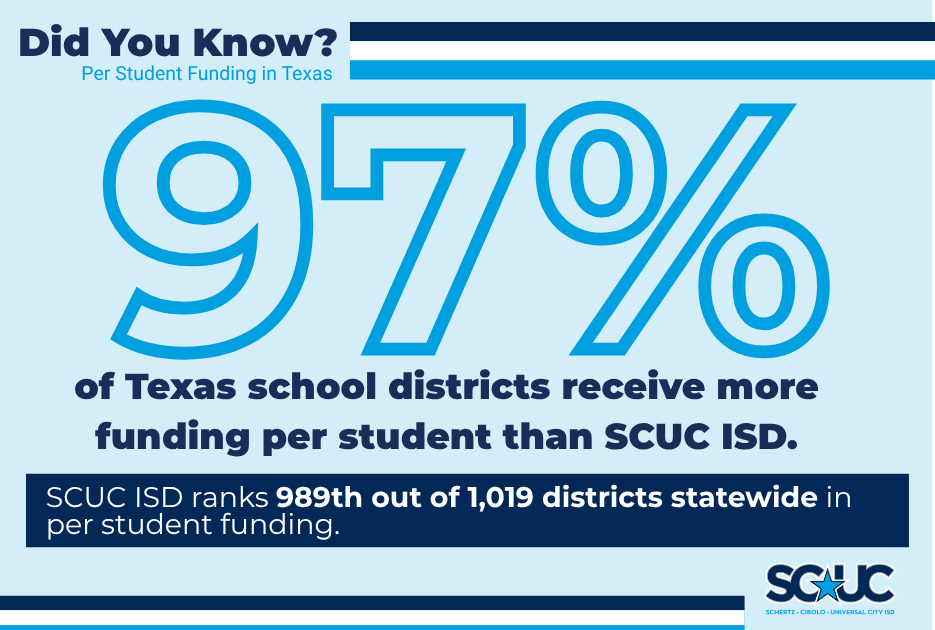
In 2024-25, SCUC ISD received $9,539 in revenue per student, compared with the Texas average of $10,828. That ranked SCUC ISD 989th out of 1,019 school districts statewide.
So, why the difference?
The short answer: There isn’t just one reason.
Texas school finance is complex. The amount each district receives is determined by a state funding formula that considers multiple factors. Here are a few important pieces that help explain SCUC ISD’s funding picture.
Enrollment + Attendance
The number of students enrolled in SCUC ISD matters, but so does how often those students are actually in school.
Texas does not simply fund school districts based on the total number of students enrolled. Much of the state funding formula is based on Average Daily Attendance (ADA), which reflects the percentage of time enrolled students actually attend school.
For example, a district may have 15,000 students enrolled, but if its average daily attendance rate is 94%, the funding calculation reflects approximately 14,100 students in attendance, not all 15,000 students enrolled.
That means both enrollment and attendance affect district revenue. When enrollment declines, there are fewer students generating funding. And when enrolled students are absent, the district does not receive the same funding it would if those students were in attendance.
This is one reason seemingly small changes in attendance can have a significant financial impact across a district our size.
The State Funding Formula
Texas does not simply provide every school district with the same amount of funding for every student.
The formula begins with a basic level of funding and then includes additional funding based on factors such as student needs and district characteristics. Local property tax collections and state funding also work together within the system.
That means two school districts with similar enrollment can have different funding amounts per student.
Tier 2 Funding
There are two tiers in the state’s school funding system. Tier 1 focuses on “per-student” funding. Another important part of SCUC ISD’s funding picture is Tier 2 funding.
Texas school districts can generate additional operating revenue through what are commonly referred to as “golden” and “copper” pennies. Some of these pennies can be accessed through action by a school board, while additional pennies require voter approval through a Voter-Approval Tax Rate Election (VATRE).
SCUC ISD is among the relatively few school districts in our area that have not accessed all available Tier 2 pennies through a VATRE. Many neighboring districts already have voter authorization to access some or all of this additional funding.
This is one factor contributing to differences in revenue per student between SCUC ISD and other districts. It is not the only factor.
Want to learn more? Raise Your Hand Texas has created a video that breaks down the Texas school funding system.
Video Resource: Where Does Texas School Funding Come From?
Why Does This Matter
Understanding how our schools are funded provides important context for the financial decisions facing SCUC ISD.
Over the past several months, the Operational Sustainability Committee (OSC) has examined district revenues and expenses, enrollment trends, and opportunities to operate more efficiently while protecting the classroom experience.
For the 2026–27 school year, this work has helped identify $6 million in savings and operational efficiencies.
But there is much more to SCUC ISD’s financial picture than any single number.
We invite our community to dig deeper into the data, learn about the work already underway and better understand how public school funding impacts SCUC ISD.
Explore the Operational Sustainability Committee’s (OSC) work: OSC webpage